

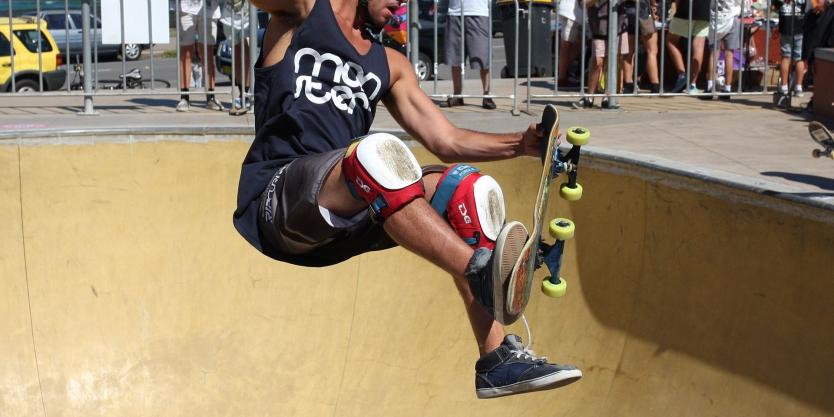
You’re probably wondering where this article is headed, given its title.So I’ll tell you right off the bat – ‘rise and grind’ refers to one of many skateboarding tricks; wherein a skater slides along an object just narrow enough to fit in between the wheels of the board (which are also known as the trucks).
Skateboarding, which originated in the late 1940s to early 1950s, can be performed solo or as part of a team. The main purpose of skateboarding is for entertainment (or for some lucky people, it’s a form of employment), but for some — as is often seen on upper campus — it is a healthy, both for themselves and the environment, mode of transportation!
In South Africa, skateboarding has recently risen significantly in popularity, with the Kimberly Diamond Cup being founded in 2015. It has been running for less than a year, but already has gained much attention in holding The African Street Skateboarding Championships (ASSC), an initiative that was sanctioned by the World Skateboarding Grand Prix. The reason the ASSC was developed was to increase the standard of skating on the African Continent, and it has allowed the top African skaters (on the continent and the outlying islands) to flourish on a global platform – an opportunity that wasn’t previously available to them. The skaters compete for various cash prizes, as well as for the grand title of ‘African Skateboarding Champion’.
If you thought that the Kimberley Diamond Cup wasn’t giving back, think again. In 2011, they started Skateboards For Hope (SFH), a community outreach initiative, which hosts youth outreach events all through the winter. The SFH initiative comprises of positive messages given at various skateboarding clinics, along with giveaways and a skateboarding contest. The contest gives the winner an entry into the TopGrom Championships, and to the South African Street Championships at the Kimberley Diamond Cup.
The skateboard has paved the way for many other boards that have come after it, such as the boosted board and the J board. For those who are not keeping up with the latest (and greatest) inventions, the boosted board is an electric skateboard with a motor that can propel the rider at various speeds, whil the J board is a board with two sections — with a wheel on each — that are joined by a cylinder. The J board is propelled forward by ‘wobbling’ the back half of the board. So there you have it — the skateboard is on the rise, so look out for the next Kimberley Cup coming up this Spring!
Did you know?
Skateboarding originated in California, as the waves were too weak for surfing — so people created a surfboard with wheels
The first commercial skateboard — the ‘Roller Derby’ — was manufactured in 1959, and its wheels were made of clay
Florida bought the first outdoor skate-park in 1976
Skateboarding is predominantly portrayed as a male-dominated sport. The first female professional skateboarder in history was Patti McGee
Alan Gelfand invented the ‘Ollie’ (a famous skateboarding trick) and is even credited for its invention in the Oxford English Dictionary.
The highest ‘Ollie’ that has ever been recorded was 45 inches high! (114.3 cm)
Written by: Shelby Labuschagne
Originally published: varsitynewspaper.co.za/sports/4625-rise-and-grind
