

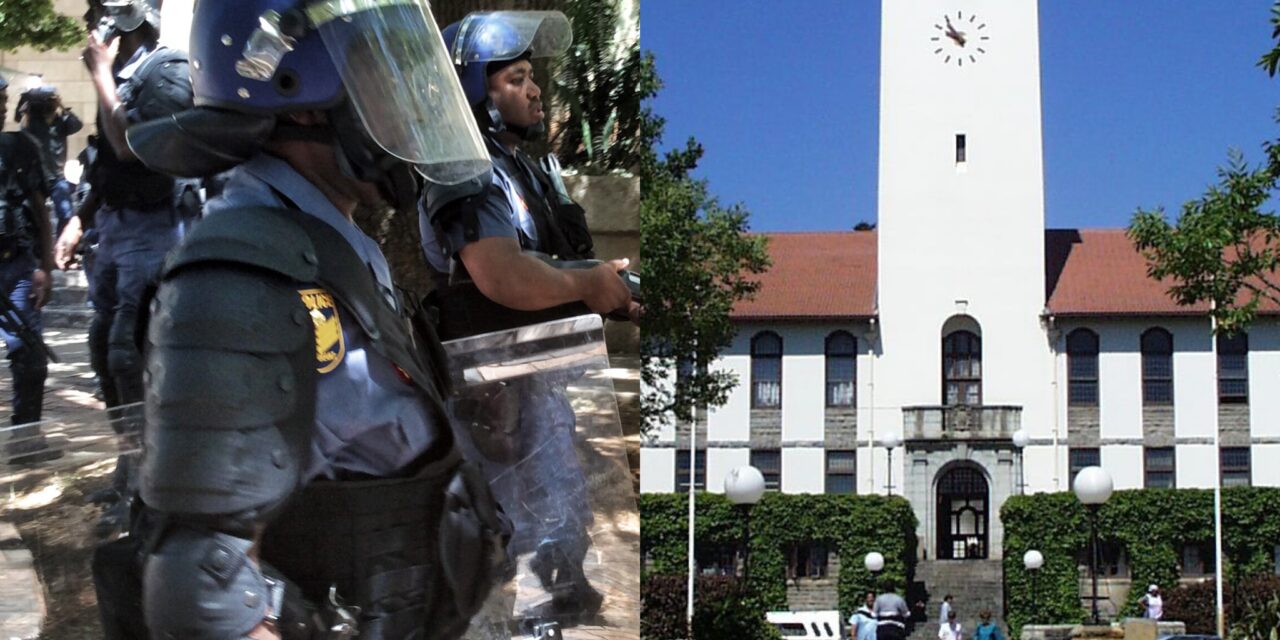
Scenes of conflict between police officers and #FeesMustFall protesting university students have gone viral both nationally and internationally. Protesting students across the country have requested that police be removed from campuses. On October 20, Rhodes university newspaper Oppidan Press announced that it too would be filing a statement concerning police brutality on campus.
Oppidan Press said, “We will be filling our own statements as student press and students with regards to police intimidation, censorship and brutality.” In the statement it was also mentioned that students would “be marching to the police station in Grahamstown tomorrow to open a case against the SAPS with regard to the heightened police intimidation and police brutality on UCKAR campus over the past 4 weeks.”
The statement went on to urge students to come forward and file their own respective personal statements and accounts of police brutality that they may have endured. The statement makes concluding remarks regarding national media’s inability to detect and display the afore-mentioned police brutality. The statement ended with Oppidan Press urging national media to pay attention to the narratives of the students.
Journalist from Oppidan Press on police presence
Student News Grid spoke to Leila Kidson, Oppidan journalist, to find out more about what has been happening. Kidson explained that it is the collective experiences of student journalists that had prompted Oppidan Press to join in solidarity with their fellow students against the perceived police brutality. She went on to recall some of the incidences that have led her to open a personal case of police brutality and censorship against Grahamstown SAPS. “I know of three student journalists who were shot on Monday night [October 17] and when they tried to tell police that they were media, they were ignored and continued to be shot at”, said Kidson. She then explained how the following evening, October 18, she had been stuck between stun grenades after she had repeatedly informed authorities that she was a journalist.
Kidson further mentioned that she had endured intimidation and censorship from police officials. She explained that police had stopped her on several occasions from capturing any footage, which prevented her from executing her journalistic duties. Kidson said, “When I was trying to capture footage of police brutality, I was standing behind the police officers and the one officer said ‘Stop following us or we will shoot you.’ I mean that is blatant police intimidation which is a contravention of my constitutional rights!”
Kidson went on to say that “Journalists have the right to information from the police, but whenever we tried to question them they denied us any information. We have also been kicked off campus which results in us being censored as journalists.” She also revealed that heightened tensions between police and student journalists have resulted in campus security escorting student journalists on and off campus.
Kidson also criticised national media for what she perceives as their disregard for the true narrative of the students. She said, “Whenever there is a building on fire at Wits or wherever, national media jumps to catch it yet they completely miss the police brutality that’s going on.”
Fissures between Rhodes University students and the Grahamstown police were first brought to light in a video clip captured by Oppidan Press’ Oppi TV. The clip was taken on September 28 and sparked outrage around the country as a student, Tartius Ningiza, was recorded being dragged by four policemen. The clip also shows another student being shoved by a female police officer after heated words were exchanged between the two.
Rhodes students on police presence
The evening of October 25 was described by Rhodes University student Bianca Bhina as a “hectic couple of hours.” According to Bhina, the police and students spent up to three hours fighting with police shooting rubber bullets and students throwing rocks. The fight broke out after students had attempted to derail an exam at the Jacaranda Labs in protest against the continuation of the examination program. Bhina claims that before the students could reach the labs, they were greeted with rubber bullets and teargas by police officers who had been alerted to the students’ intention.
Bhina went on to mention that police restricted students to the Union building by closing off all the exits. Bhina explained that “They then came into the actual building and shot students and released teargas in there.” She also alluded to incidences of police shootings at Milner, Jan Smuts and Atherstone residences. “A lot of casualties came from today but students are angry and will not give up the fight”, concluded Bhina.
Michael Strong, another student from the university, was allegedly shot six times by police officials. Strong was shot because he tried to get the police to stop shooting in the residence. Before he was shot, Strong managed to capture two male policemen shooting into one of the residences. A friend of Strong’s, fellow student, Tinashe Marufu posted a video of Strong indicating the wounds on his legs and back inflicted by the rubber bullets.
The post was accompanied by the following caption: “My friend Michael Strong was shot six times for taking a video of the police brutality that has been occurring on campus. He was not even protesting but look [at] what has happened. This is a clear example of the excessive force by the police. This is disgusting. How are we supposed to study and pass when campus is a warzone.”
Sinegugu Hlengane, a student and resident at Allan Gray House, recalled her traumatic ordeal with the police on October 25. Hlengane said, “Today I felt what a rubber bullet feels like. Trust me it is very painful. Worst of all I was inside my res trying to close the door.” She explained that the male officer shooting at her did so from the driveway and in the middle of the street. Hlengane also mentioned that the officer was not dressed in police regalia but rather in normal civilian clothing. Hlengane says that she was shot between her armpit and breast.
Hlengane commented on university management saying that “Management will forever take the side of the police even though clearly they are hurting us and being brutal, using excessive force.” She went on to speak about the mental and emotional wellbeing of her peers and herself by questioning whether students will be able to proceed with their examinations. According to Hlengane, management is adamant on continuing the examination programme despite opposing cries from the students. “I don’t understand how we are meant to be sane and well for the exams….mentally and physically we are not okay. We have been shot at, sworn at and ridiculed by both management and police”, said Hlengane.
Rhodes University on police presence
Student News Grid engaged with Rhodes University media relations officer Catherine Deiner in order to ascertain management’s perspective on the elevating tensions between police and students. Deiner stated that Rhodes University disapproves immensely of any violence on campus and in the greater South African society. She said that the police presence on the campus brought the management a great deal of discomfort.
Deiner said: “Members of the South African Police Services have been deployed here to ensure the safety and security of staff and students of the university, and to prevent the destruction of property.” She went on to say that the police “would not be present if we were not experiencing violent protests and disruptions on our campus, and they will withdraw when these activities cease”.
When questioned on the issue of police brutality, Deiner emphasised the importance of presenting evidence when claims of police brutality were made. She said, “Where any member of the university community has evidence that police have acted in any other way, they need to bring that evidence forward for presentation to the IPID (Independent Police Investigative Directorate), which is the only body that has powers to investigate police behaviour.”
Deiner concluded by saying that the university had no authority to investigate police behaviour and therefore could not make any pronouncements about police behaviour without possessing any evidence. She further stated that evidence brought forth by any staff or student must be substantial enough to be used in a formal hearing.
Student News Grid did try contacting the Grahamstown Police Services for a statement; however they were not available to comment.
With tensions between students and police continually escalating, the probability of completing the academic year continues to decrease. Students are enraged at police officials, while the latter claims to be executing their professional obligations. The stories at Rhodes University echo stories from students across the country, and it remains to be seen how it all will end.
Written by Tammy Fray
Editor’s note: We encourage you to share your comments on this topic and encourage lively discussion and debate. We will not tolerate trolling, hate speech, racism or any of those ugly things that you should know better than to do.
[not_logged_in]NB: You are not currently logged in. To access comment below, you will need to register on the site and log in. Once you are logged in you will be able to comment.[/not_logged_in]
